To the Ultimate "Travel Time Is Waste." Hype Over "Zero-Minute Tourism" — Just Tap Through the Gate and Go Home
"I want to travel, but getting tired is bad ROI." The new trend born from time-performance supremacy is "log collecting" — buying expensive long-distance tickets, passing through the ticket gate, and immediately exiting without boarding. People curate "fulfilling weekends" on social media using only payment history and GPS records, while actually binge-watching Netflix at home. Railway companies, buoyed by revenue from ghost passengers, have announced plans for "station data-centerification" — removing platforms and installing nothing but ticket gates.
“I want to travel, but getting tired is bad ROI.” The new trend born from time-performance supremacy is “log collecting” — buying expensive long-distance tickets, passing through the ticket gate, and immediately exiting without boarding. People curate “fulfilling weekends” on social media using only payment history and GPS records, while actually binge-watching Netflix at home. Railway companies, buoyed by revenue from ghost passengers, have announced plans for “station data-centerification” — removing platforms and installing nothing but ticket gates.
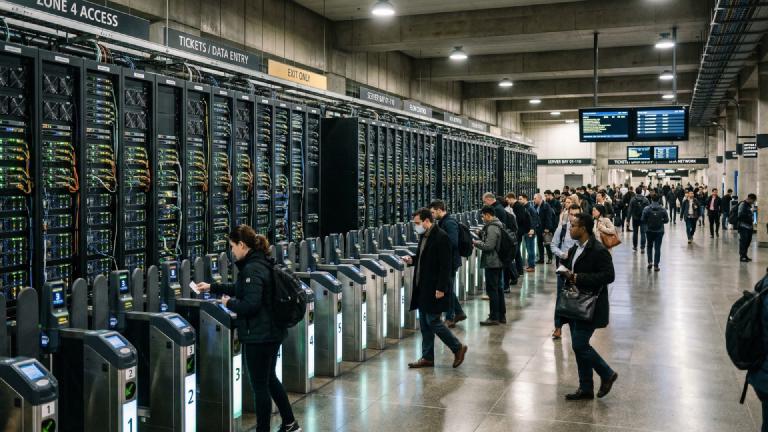
It’s the weekend at Tokyo Station, in front of the Shinkansen gates. Young people with rolling suitcases form a long queue, but not a single one shows any intention of heading to the platform. They tap their expensive digital “bound for Hakodate” tickets on the latest ticket gates, and the moment they receive the confirmation beep, they execute a fluid U-turn and slip through the exit gates. Total time: three seconds. This is the scene of “Zero-Minute Tourism,” the explosive trend sweeping Gen Z.
“Traveling is basically buffering time for your life, isn’t it? It’s meaningless.” A 24-year-old man working at a Tokyo IT company has just paid for a round-trip ticket to Hakata (roughly 45,000 yen) and completed his “Hakata trip” without taking a single step outside Tokyo. His social media instantly auto-posts: “Arrived in Hakata! Can’t wait for ramen 🍜 #BulletTrip,” and his location log dutifully records the travel history. In reality, he plans to go home, order tonkotsu ramen on Uber Eats, and watch a movie at double speed. “My body doesn’t get tired, I get likes on social media, and it feels like I’m buying time with money. Ultimate time-performance,” he declares proudly.
Behind this phenomenon lies fatigue from the overheated “experience supremacy” and an almost pathological obsession with “efficiency.” Real travel has too many “variables” — seatmate gacha (unpleasant fellow passengers), weather risks, hit-or-miss hotels. “Log travel,” by contrast, locks in only the fact that “money was paid to travel” on the railway company’s servers, reducing risk to zero. AI-generated photos fill in the Instagram-worthy shots, and nobody can tell he hasn’t moved an inch from his couch. In a sense, this is the purest and most grotesque form of “travel” that capitalism and the need for validation have ever produced.
The railway companies didn’t miss this trend either. Initially bewildered, they soon realized that “ghost passengers” — who pay fares without actually being transported — are a gold mine requiring no fuel or labor costs. Toto Railway will launch its “Server Station Plan” next month, partially closing platforms at major terminal stations and lining those spaces with 500 ticket gates. It’s no longer a place to wait for trains. It is transforming into a massive authentication center where people receive proof that they “traveled.”
Local governments have also jumped on the frenzy. “You don’t have to come — just leave a log.” One depopulated area’s tourism board launched a “Virtual Homecoming Plan” that ships local specialties to your door as long as you have a gate-passing record — no actual visit required. The honest desire of “tourists create garbage and are a hassle to deal with” and the urban dweller’s need to “donate if I don’t have to actually go” have found a miraculous match. The old common sense that regional revitalization means people moving appears to be powerless against high-speed fiber optics.
However, “Zero-Minute Tourism” has its pitfalls. The fundamental question is: what do you do with all the time saved by pursuing maximum efficiency? Many practitioners reportedly spend their vast free time on infinite short-video scrolling and consuming content at double speed. Having eliminated the physical waste of “travel,” humanity may, in the end, be nothing more than brains adrift in a digital ocean, tossed about by waves of information.
In the station concourse, the cheerful electronic sounds ring out again today. Beep, turn, beep. The sound of journeys where nobody goes anywhere echoes — hollow, yet triumphant.
Stakeholder Comments
- Zero-Minute Tourism Enthusiast (College Student): “Last week I ‘went’ to Hokkaido, this week Okinawa. I earn miles, my friends call me active, and I’m actually in pajamas the whole time. This is the modern optimal solution.”
- Railway Company, Head of Corporate Strategy: “Honestly, transporting humans is too expensive. They’re heavy and they complain. Transporting only logs — that’s the future of railways.”
- Ticket Gate (No. 405): “I used to be busy only during rush hours, but now I’m being tapped all day long. Nobody passes through me anymore. Am I just a punching bag?”
- Rural Hot Spring Inn Owner: “We’re fully booked even though no guests are coming. It’s a mysterious phenomenon. I don’t have to lay out futons anymore, so my back pain has healed.”
- Travel Influencer: “If you actually go to the destination, editing photos takes forever. With Zero-Minute Tourism, you can use AI-generated images from the start, tripling your posting efficiency.”
- Social Psychologist: “Humanity detaching proof of existence from physical space sounds like evolution when you put it nicely — but it’s really just the gentrification of being a shut-in.”
- Office Worker on Virtual Homecoming: “I tell my parents, ‘I tapped the log again this year.’ Increasing the remittance amount makes them happier than seeing my face.”
- Station Kiosk Staff: “More people are passing through the gates ‘just to buy souvenirs.’ They finish shopping inside the gates and go straight home. The station has become a giant convenience store.”
- Non-Train Express Ticket: “I am an express ticket with no seat. I will guide you to a non-existent reserved seat on a non-existent train.”
- Construction Worker: “Jobs to demolish platforms and convert them into server rooms are surging. Never thought I’d see the day we rip up railroad tracks.”
International Expressions
Haiku
- Spring breeze blows / through the ticket gate and out — / straight back home
- No journey taken / yet the log remains behind — / cherry blossoms fall
- A ticket purchased / for a trip never traveled — / oh, the costly fare
- Station of the void / people circling endlessly — / where do they all go
- A distant city / touched only through the display — / nothing more than light
- Ticket gate echoes / its sound alone resounding — / an unmanned station
- Time-performance — / the demon that devoured / the soul of travel
- Bound for Hakodate / neither heart nor body goes — / just the receipt stays
- Buying only logs / gazing at the spring sea / from inside my room
- Rails rusting away / while data speeds down the tracks — / across the islands
Kanji / Chinese Characters
長距離切符購入即帰宅 移動時間完全削減 虚構充実週末演出 鉄道会社莫大増収 駅舎変貌電子認証場
Emoji
🎫🏃💨🔄🏠📱✅🚄❌📺🍿
Onomatopoeia
Beep! Spin. Click-clack-click-clack. Ka-ching! (Payment complete.) … (Platform silence.) Chatter-chatter (In front of the gates.) Tap! (Social media post.) Buzz-buzz (Notification.)
SNS
- #ZeroMinuteTourism and I even got the Green Car log! The flex is real lol
- People still physically traveling? What is this, the Stone Age? #TimePerformance
- The U-turn squad at Tokyo Station has their moves down to an art 😂
- Paid 30,000 yen for the right to sleep at home. Best Sunday ever.
- Hey railway companies, do you even need trains anymore? #StationDataCenter
- The key to log travel is choosing the right Uber Eats to “feel like you went.”
- Anyone know a service that’ll tap through the gate for me? Even that’s too much effort.
- It’s not GPS spoofing — I paid the official fare. It’s “legitimate”!
- Cut all travel risks (delays, crowds, fatigue). This is the smart life.
- “Don’t you feel empty?” they ask. Better than dragging myself to Monday exhausted.