Bird Strikes Rebranded as Childcare Support: Government Designates Incidents as 'Stork Cases'
Transport authorities have redefined bird strikes as "childcare support provided by stray storks." Airlines are now required to submit subsidy paperwork before accident reports, and mechanics find themselves removing attached documents rather than feathers from engines.
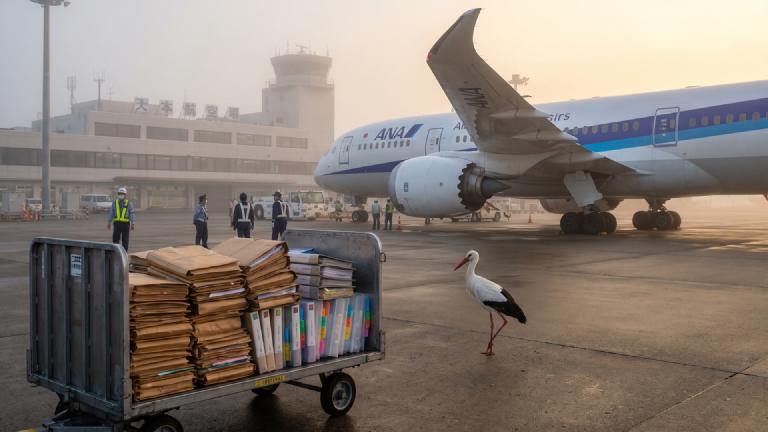
Transport authorities have redefined bird strikes as “childcare support provided by stray storks.” Airlines are now required to submit subsidy applications before filing accident reports, and aircraft mechanics find themselves pulling out attached documents rather than bird feathers from jet engines.
The new guideline released by transport authorities on the 8th, titled the “Procedures for Handling Avian Collision Childcare Support,” positions runway bird strikes as “in-kind support falling from the sky in an era of declining birthrates.” While birds remain inherently unpredictable, changing the terminology appears to soothe the statistics—revealing the bureaucracy’s unwavering faith in administrative order.
Incidents are officially designated as “Stork Cases.” Immediately following a collision, airlines must log into a dedicated portal and upload damage photos along with a “Support Implementation Report.” Checkboxes on the form include categories such as “Watching Over” and “Holding/Cuddling (Presumed),” forcing pilots to circle administrative checkboxes even before executing a go-around.
On the tarmac, maintenance mechanics grapple with staple pins before even extracting feathers from turbines. If the attachments to the application form are deemed insufficient, the claim is rejected on the grounds that “the fact of support cannot be verified.” An airport economy where staple removers outsell torque wrenches resembles a triumph of stationery over aeronautical science.
Aviation safety researchers remain skeptical, remarking, “Redefinition does not amend the laws of aerodynamics.” Nevertheless, authorities created a provisional list designating seagulls and pigeons as “quasi-storks,” explaining that this ensures fairness. Ornithologists lament that “taxonomy is not a convenient administrative purse,” but this is an age where purses themselves dictate taxonomic classifications.
Some local municipalities, eager to secure subsidies, have even voiced a desire to attract more birds, floating ideas to transform airport surroundings into “Sacred Grounds for Parenting.” As a result of placing flight safety and future social welfare at the very same administrative counter, priorities have come to be decided by the thickness of paper stacks. In skies where the thud of official stamps echoes louder than the flap of wings, it seems birds are not the only ones who have lost their way.
Stakeholder Comments
- Transport Ministry Official: “Confirming the bird’s intention is difficult, but the confirmation box on Form No. 3 is crystal clear. That is predictability.”
- Airline Flight Operations Director: “Safety first, stamping first. In the cockpits of the Reiwa era, two ‘firsts’ must comfortably coexist.”
- Aircraft Mechanic: “Feathers can be pulled out. Attached documents cannot. The staple is the most formidable force in nature.”
- Air Traffic Controller: “I never thought the day would come when ‘bird’ sounds like ‘baby.’ Interference prevention starts with the Maternal and Child Health Handbook.”
- White Stork (Self-proclaimed): “They called me stray, but the only thing truly lost is the destination of the national budget.”
- Application Portal AI: “Entry takes 3 minutes; attachments take 3 hours. Please count your waiting time as part of the childcare support.”
- Jet Engine: “Metal endures, but paper scorches. And scorched paper only summons the next stack of paper.”
- Passenger (Parent): “The impact was terrifying. But when they announced we were ‘receiving support,’ I strangely felt guilty.”
- Stationery Shop Owner near Airport: “Clips sold out faster than anything on the runway. The future is fastened together by tiny pieces of bent wire.”
- Maternal and Child Health Handbook (Conceptual): “Even with a 0% presentation rate at check-in, confirmation stamps multiply endlessly. I wish I could learn that trick.”
International Expressions
Haiku
- Feathers flutter down / Applications fill the sky / Moments before flight
- White stork on the strip / Clutched tightly within its beak / Endless KPIs
- Spring breezes whisper / Faster than accident reports / The seal must be stamped
- Mechanic’s dark hands / Smudged not with aviation grease / But with paper ash
- A lost bird takes flight / Heading straight into the clouds / Where the budget flies
- Stacks of official forms / Sucked inside the jet turbine / Bursting into flame
- Meant to raise the child / But caught in the gears instead / Supported by paper
- Fastening our fate / Safety and order bound tight / Click of the staple
- In the control tower / Binoculars scan through mist / Circling ‘Approved’
- Future peace of mind / The application complete / Effective at once
Kanji / Chinese Characters
国交当局鳥衝突育児支援再定義
航空会社事故報告前支援金書類提出必須
整備士羽根前添付書類抜取
Emoji
🛫🐦💥➡️👶🧾💴🧰🪶📎
Onomatopoeia
Kaboom, flap-flap, click-clack, slap-slap, clunk, glide, thump-stamp.
SNS
- “Bird strike → claim subsidy first.” Priorities are ascending faster than our cruising altitude.
- There’s a theory that the application button for #StorkCase is actually the aircraft’s primary safety device.
- More paper came out of the turbine than feathers. Is this the Digital Transformation we were promised?
- Postponing accident reports while preaching “administrative order” takes some serious nerve.
- Authorities: “We redefined it.” Frontlines: “Could you please redefine reality instead?”
- The checkbox for “Holding/Cuddling (Presumed)” posing as a serious technical term is the scariest part.
- Airport running low on staple removers, sparking a quiet panic #StationerySecurity
- More lost government departments than lost storks—classic bureaucracy.
- If childcare support drops from the sky, my sleep deprivation deserves a high-altitude hazard allowance.
- You have to admire the sheer audacity of putting “future peace of mind” and “flight safety” at the exact same counter.