Ministry of Efficiency Dismantled to Create "Agency of Waste": Only Waste and Overtime Pay Are Growing
The government announced the sudden dismantling of the Ministry of Efficiency, once the symbol of administrative reform, and the establishment of a new "Agency of Waste" on its former site. Staff print expense slips by the kilogram starting in the morning and spend the night burning through leftover budgets by turning them into confetti. A finance bureaucrat boasted, "The only things growing in Japan are waste and my overtime pay."
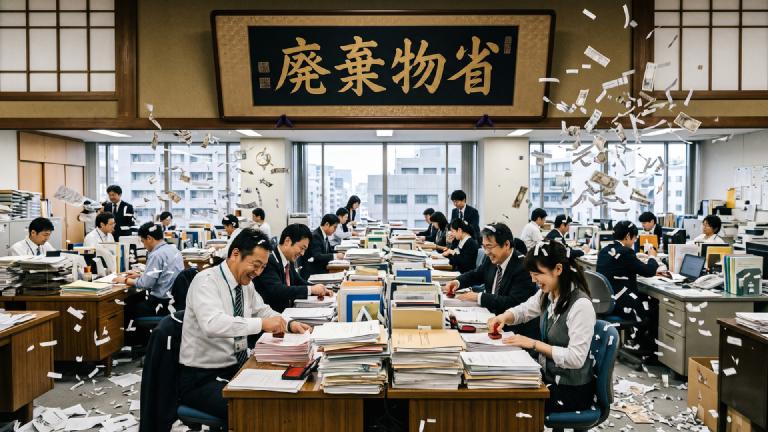
The government announced the sudden dismantling of the Ministry of Efficiency, once the symbol of administrative reform, and the establishment of a new “Agency of Waste” on its former site. Staff print expense slips by the kilogram starting in the morning and spend the night burning through leftover budgets by turning them into confetti. A finance bureaucrat boasted, “The only things growing in Japan are waste and my overtime pay.”
According to government officials, the Agency of Waste has been positioned as a “new pillar of the growth strategy.” In an internal review, the government concluded that its policy of cutting expenditures through efficiency had “caused anxiety among the public,” and pivoted under the highly optimistic reasoning that “if we simply don’t cut anything from the start, no anxiety will arise.” At the building that once housed the waste-eliminating Ministry of Efficiency, a new sign has already been hung. The old sign is expected to be reordered as a commemorative souvenir utilizing the “recycling budget allocation.”
The work inside the agency is straightforward. Mornings are dedicated to mass-printing and binding expense slips and approval documents, afternoons feature a stamp-pressing competition on those very same documents, and evenings are scheduled for a confetti show dubbed the “Fiscal Year-End Budget Exhaustion Illumination.” The Digitalization Promotion Office was the very first to be abolished, replaced by a newly established “Carbon Copy Promotion Office.” Rather than Gross Domestic Product, the agency’s key performance indicator has been set as “Gross Domestic Procedural Volume,” aiming for double-digit year-on-year growth in its first year. Nearly all of that growth will be funded by forest resources and the patience of the public.
Fiscal authorities describe this reorganization as “visualizing fiscal management.” By consolidating wasteful spending—previously carried out quietly in the corners of Kasumigaseki—into a single agency, the aim is to clearly show the public just how much is being squandered. Estimates suggest that overtime allowances will surge with the creation of the Agency of Waste, potentially adding a new category—“Civil Servant Overtime-Driven Boom”—to household expenditure surveys. One veteran bureaucrat remarked, “At last, our all-nighters and the fiscal deficit will be properly appreciated head-on.”
Meanwhile, opinions among economists are divided. One professor pointed out, “It is a classic fiscal stimulus, yet an exquisitely sophisticated stagnation policy that builds mountains of paper without even digging a hole just to fill it back in.” Another researcher focused on the cyclical effect in which growing public anxiety about the future increases the savings rate, which in turn generates “surplus funds for waste.” They analyzed it positively, stating, “This is wasteful sustainability, achieving sustainable stagnation.”
Naturally, an impact on the public burden is also anticipated. Rather than a traditional tax hike, the government is reportedly considering a “gone-before-you-notice method” that collects broadly and thinly. Specific proposals floating around include printing receipt text in microscopic font to tack on additional tax burdens before consumers can even realize what they bought. As a citizen-participation initiative, the Agency of Waste is also planning a pilot project to collect unused household items under a “Mottainai Spirit Suppression Subsidy” and render them even more useless.
Having come full circle, the Ministry of Efficiency, once the flagship of administrative reform, has ended its historical role as the “most inefficient entity of all.” The nation’s growth strategy has deliberately veered off the straight road of rationality and stepped onto a winding mountain path. Does a new industry lie ahead, or a fiscal black hole? The national slogan is shifting from “What a waste” to “Let’s waste it lavishly.” How long the public’s patience and wallets will hold out remains a subject for future verification.
Stakeholder Comments
- Director of the Agency of Waste Preparatory Office: “We want to centralize the waste that has been carried out piecemeal until now and efficiently promote inefficiency.”
- Former Ministry of Efficiency Staffer: “Our workload never decreased; only our reason for existing was cut. This time, we can waste things with pride.”
- Senior Ministry of Finance Official: “Fiscal discipline is important, but we cannot afford to crush our only growth industry: overtime pay.”
- Ruling Party Policy Chief: “Seeking economic stimulus measures close to people’s daily lives, we decided to start by spending tax money.”
- Opposition Lawmaker: “Some criticize this as merely changing the sign, but since the cost of the sign itself is an extra expense, it is clearly a step backward.”
- Economist: “This is advanced behavioral economics based on the insight that printing and throwing away documents suits Japanese culture better than digging a hole and filling it back in.”
- Civil Servants’ Union Representative: “Unpaid overtime continued under the name of efficiency. From now on, we can proudly demand waste-surcharge overtime.”
- Budget Turned into Confetti: “If I was destined to vanish anyway, I at least wanted to dance dazzlingly through the air.”
- Taxpayer’s Wallet: “I’m not growing, but I’m definitely getting lighter. I suppose this is a kind of diet.”
- Voiceless Voice of Future Generations: “There are mountains of explanatory materials, yet the fact that nobody reads them is the biggest waste of all.”
International Expressions
Haiku
- Piling up the waste / The national growth strategy / Becomes a mountain
- Budgets dance aloft / Late at night in office halls / Falling confetti
- Casting off restraint / Of efficiency, we found / Overtime paychecks
- A dark gaping hole / Swallowing fiscal soundness / Mist rises on high
- Echoes of the stamps / Ringing down the corridors / Spring remains afar
- Agency of Waste / Carrying the future on / Stacks of IOUs
- Rain of paper slips / Starts to pour down heavily / On closing day’s eve
- Taking the long way / The road of growth strategy / Becomes a lost path
- Fireworks of funds / Bursting open in the sky / Leaving only dark
- Even in Reiwa / Approval forms making rounds / A journey of sheets
Kanji / Chinese Characters
政府行革象徴効率化省解体跡地無駄遣庁新設発表職員朝伝票大量印刷夜余剰予算紙吹雪処理財務官僚唯一伸無駄残業代強調
Emoji
🏛️📑📑📑➡️🗑️🎊
💴💴💴⤵️🌀
👔😅⏰🌙💤
Onomatopoeia
Clatter-clatter, clickety-clack, thump-thump
Drag-drag, rip-rip, flutter-flutter
Creep-creep, thud, whump
Flip-flip, round-and-round, plop
Beep-beep, ka-chunk, ka-chunk
Float-float, scatter-scatter, silence
SNS
- #AgencyOfWasteBorn
- Nobody told me this would be the result of administrative reform
- Apparently overtime pay is the only thing trending upward
- #YearEndBudgetSpendingFest
- “MinistryOfWaste” is such a power word
- The day the fiscal black hole became an official government department
- Went from “Wait, the Ministry of Efficiency still existed?” to “Now that it’s gone, welcome to the Agency of Waste”
- Might as well give some of that confetti back to the taxpayers
- That receipt addressed to future generations is way too long
- The growth strategy isn’t just taking a detour, it’s completely lost #PolicyAdrift