Tea Gathering Officially Classifies Numb Legs as "Lingering Resonance": Chair Applicants Asked to Stand to Apply
After finishing a bowl of matcha, a guest offered compliments on the tea, attempted to rise, and promptly plopped back onto the tatami mat. The hosts added this period of immobility to the official program under the title "Lingering Resonance." Meanwhile, guests wishing to request chairs for future sessions are instructed to stand up and raise their hands.
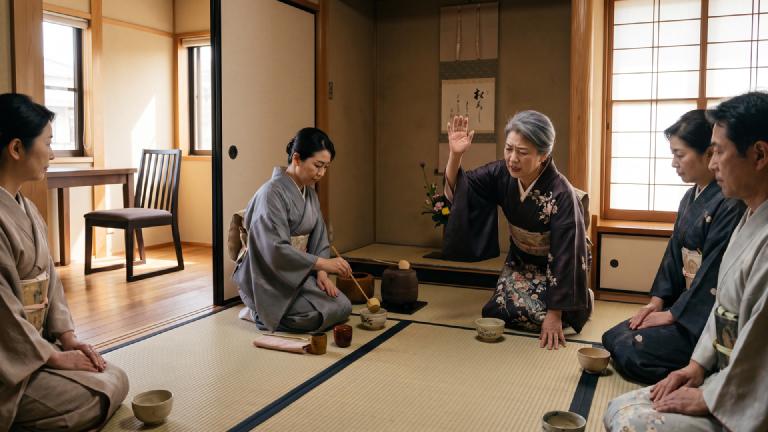
After finishing a bowl of matcha, a guest offered compliments on the tea, attempted to rise, and promptly plopped back onto the tatami mat. The hosts added this period of immobility to the official program under the title “Lingering Resonance.” Meanwhile, guests wishing to request chairs for future sessions are instructed to stand up and raise their hands.
As autumn sunlight filtered into the tearoom, the guest returned the tea bowl and bowed deeply according to instruction. The trouble began right after. The moment they attempted to get up, all sensation in their legs clocked out and went home first, leaving their body to make a gentle emergency landing back onto the tatami. The surrounding onlookers hesitated over whether to laugh or lend a hand, while the guest, wearing an expression far darker and more intense than the matcha itself, managed to murmur, “Please give me just a moment.”
Organizers explained that incorporating “Lingering Resonance” into the schedule was intended to ensure guests never felt rushed to leave. If everyone waits together until the guest with pins and needles can stand, the delay ceases to look like an individual’s personal failure. As a gesture of hospitality, the reasoning appears sound. However, what the guest is left savoring is rarely just the lingering notes of green tea—it is also the mounting anxiety over whether their knees will ever resume normal operations.
Before long, the facilitator ran into a dilemma: determining when this “Lingering Resonance” had actually run its course. From the outside, a guest meditating serenely on the beauty of a tea bowl looks virtually identical to one desperately waiting for feeling to return to their toes. Unable to usher in the next seating group, only the tearoom clock kept ticking along with the ritual etiquette. Among the guests, quiet worries began to surface: “Will staying in resonance longer make me look more devoted?"—loading the peaceful silence with unnecessary subtext.
To address the situation, the organizers decided to accept reservations for chair seating starting from the next gathering. The protocol: stand up in the tearoom and raise one’s hand to declare interest. While intended as a clear procedure so no requests would be overlooked, for guests who need chairs precisely because they cannot stand, the entrance to the process seemed farther than the exit. As the coordinator called out, “Whenever those who are able to stand are ready, please proceed,” several attendees quietly looked down at their own motionless feet.
Regarding one guest who raised a hand while remaining seated, staff initially explained that “verification of standing had not yet been confirmed.” If the objective was simply to confirm the person’s intent, the raised hand did its job admirably. Nevertheless, in this setting, the legs were assigned the responsibility of serving as the application form. The extra resonance conceived to accommodate guests had transformed into an agonizing interval during which people contemplated whether their legs qualified them to ask for a chair.
The tea ceremony does offer an alternative format known as ryurei, which allows participants to enjoy tea while seated on chairs. Several attendees suggested, “Could we keep the tranquility while dropping the standing requirement?” Organizers took the feedback to heart, stating they would look into arranging ryurei seating. If guests are spared the ordeal of forcing themselves upright, their hands can finally hold the tea bowls with genuine ease. A tea gathering, after all, should hardly be an endurance contest for the knees.
For upcoming events, organizers announced plans allowing participants to apply for chair seating orally while remaining seated. Guests suffering from pins and needles are advised not to stand by force until full feeling returns. Yet during the committee meeting that finalized the policy change, someone called out for a vote: “All in favor, please rise.” The few seconds everyone spent gazing downward at the tatami became the longest lingering resonance of the day’s proceedings.
Stakeholder Comments
- Organizer: “We introduced ‘Lingering Resonance’ so that our guests would never feel hurried. We certainly have no intention of billing overtime.”
- Facilitator: “I used to be in charge of signaling when it was time to depart. Now my job is waiting for guests’ legs to reply.”
- Tea Ceremony Historian: “There is already the ryurei tradition of using chairs. If we wish to discuss tradition, we can always sit down and talk it over first.”
- Physical Therapist: “Pins and needles are not aesthetic ambiance; they are notifications from your nervous system. Please don’t just leave them on ‘read’.”
- First-time Guest: “With everyone sitting in total silence, I felt as if my knees were the only ones speaking at the top of their lungs.”
- Guest Requesting a Chair: “I want to sit next time, but to ask for it, I must stand. It feels like my legs are undergoing an employment interview.”
- Accompanying Guest: “I wasn’t sure if offering a hand broke decorum. Next time, instead of guessing etiquette, I’ll just ask the person directly.”
- Tatami Artisan: “The tatami cushioned the tumble, but our workshop never invoiced for ‘Lingering Resonance’.”
- Chair: “I have been standing here waiting the whole time. There is no good reason to make the people who need me stand up too.”
- Numb Legs: “I am a biological warning signal. I have no recollection of being hired by the cultural affairs department.”
International Expressions
Haiku
- Autumn tea is sipped; / straight from unyielding knees comes / the voice of the fall.
- Kneeling comes to end, / but the urgent call to legs / brings no reply yet.
- Stuck upon the floor; / asking for a chair requires / standing up once more.
- Autumn tea ceremony: / etched into trembling legs rests / enduring manners.
- Tea bowl placed in peace; / the mind has already flown / out into the hall.
- Hand longs to rise up, / but well before the arm moves / feet have gone to sleep.
- Empty chair in sight; / eligibility checked / against numb, stiff limbs.
- Feet struck with numbness; / keeping up a straight-faced gaze / called refined taste.
- Shadow of a chair; / only the formal request / manages to stand.
- Knees tremble and give; / while the tea rests quietly, / slowly growing cold.
Kanji / Chinese Characters
茶会客抹茶飲用後起立失敗畳着座主催者足感覚異常余韻認定式次第追加次回椅子席希望者起立挙手申請要請
Emoji
🍵😌🙇⬆️🦵⚡️🫠🟩📋✨🪑🙋🦵⚡️
Onomatopoeia
Gulp, glide, tingle-prickle, plop. Silence, rustle. Rise, reach… tingle-prickle, plop.
SNS
- Finished every drop of matcha, yet my legs refuse to leave the tearoom. #TeaCeremony #Seiza
- If the prerequisite to apply for a chair is being able to stand, why does the chair even exist? #ChairSeating
- When someone whispers “what deep resonance,” what I really need is a hand up from the tatami. #NumbLegs
- My mind wants to savor the tea. It really doesn’t want to oversee the reboot of my knees. #TeaCeremony
- Requiring people to stand up to prove they cannot stand—a brand-new Zen riddle. #StandingApplication
- In the quiet room, my legs are the only ones yelling, “Wait just a second!” #Seiza
- Matcha enjoyed on a chair tastes just as delicious. You don’t need to ask your knees to know that. #ChairSeating
- When they urged us to “take our time,” I had no idea it was a strictly literal directive. #TeaCeremony
- Sitting applicants are now allowed to apply from the floor. Kindness finally caught up before the chair did. #ChairSeating
- Today’s takeaway: leave the resonance in the tea bowl, and let numb legs rest without forcing them. #TeaCeremony