Underground Nuclear Test Vibrations Win Top Art Prize as "Earth's ASMR," Praised as "So Chill"
The artwork "Gaia's Sleeping Breath" won the Grand Prize at an international contemporary art exhibition. While its deep bass was praised as "the heartbeat of Mother Earth," it was later revealed to be shockwave data from an underground nuclear test. However, even after the truth came out, no protests arose; instead, in an unprecedented turn of events, a petition demanding its release on Spotify has launched, with listeners saying it helps them sleep and makes great background music for work.
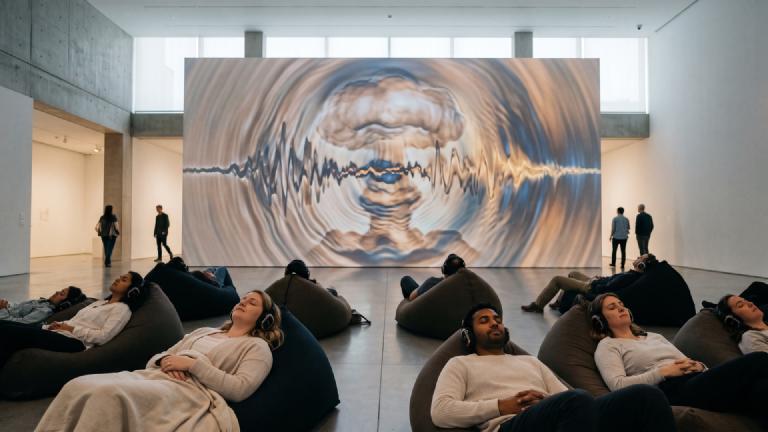
The artwork Gaia’s Sleeping Breath has won the Grand Prize at an international contemporary art exhibition. While its deep bass was hailed as “the heartbeat of Mother Earth,” it was later revealed that the sound was actually shockwave data from an underground nuclear test. However, even after the truth was made public, no voices of protest were raised; instead, an unprecedented situation has unfolded as a petition campaign launched demanding its release on Spotify, with fans saying “it helps me sleep so well” and “I want it as background music for work.”
On the 19th, the awards ceremony venue for the “4th World Silence Biennale,” a festival of contemporary art, was enveloped in an eerie quiet and the sound of gentle snoring. The Grand Prize-winning piece, Gaia’s Sleeping Breath, is a sound installation that converts deep, resonant vibrations—sounding as though they echo from the depths of the earth—into the audible spectrum and plays them through specialized subwoofers. Jury Chairman Marcel Dubois tearfully praised the work, saying, “It captures the ‘fetal movement’ emitted by the Earth itself as a living organism. It is the ultimate healing experience, inviting the listener to return to the womb.”
Immediately after the awards ceremony, however, the situation took a sudden turn. The creator, an anonymous artist going by the name “R. Oppenheimer II,” released a statement revealing that the audio source was actually seismic wave data from a top-secret underground nuclear test conducted by a certain country last month. The artist’s intent—“This is the scream of the Earth and a wake-up call to humanity’s folly”—was an unmistakable political message, and it was supposed to throw the venue into an uproar.
Yet the audience’s reaction completely defied the organizers’ expectations. Upon learning the truth, Gen Z visitors casually remarked, “Wait, it was a nuke? LMAO,” “But honestly, isn’t it super chill?” and “You can really feel the vibes reaching deep into your core,” before sinking right back into their beanbag chairs. One beauty influencer immediately shared it on social media, posting, “I never thought the sound of a nuclear explosion could align my energy like this. Destruction is creation—this is the ultimate detox,” racking up millions of likes in the blink of an eye.
In response to the commotion, environmental groups and peace activists began preparing statements of protest, but public interest had already shifted to “where can we listen to it?” A petition calling for the official release of the audio on the major music streaming service Spotify surpassed 500,000 signatures within three hours of its launch. The comments section has been flooded with feedback and requests such as “It cured my insomnia,” “It helps me focus on exam prep,” and “Please remix the test sounds from neighboring countries too,” marking an unexpected shift in which nuclear tests—once objects of terror—are beginning to be consumed as lifestyle content.
Sociologist Professor Arthur K. Middleton analyzes this phenomenon as the “ASMR-ification of the Apocalypse.” “Modern people are so saturated with anxiety and stress about the future that they are now in a psychological state where, even if the source of a stimulus is ‘ruin,’ they will embrace it as long as it brings pleasure. We live in an era where even a nuclear winter might be reviewed as ‘cool and comfortable,’” he warned—though at present, his voice of caution is likewise being drowned out by the soothing deep bass.
Currently, over the rights to the audio source, the Ministry of Defense of the country that conducted the test is preparing to claim neighboring rights as the “performer.” Steering away from “peaceful use” toward “restful sleep use,” the nuclear threat has taken a bizarre turn. Humanity may have finally turned even the sound of its own destruction into a lullaby. The scheduled date for the next test is now drawing eager anticipation from audiophiles and insomniacs around the world as a long-awaited “new single release date.”
Stakeholder Comments
- Anonymous Artist R. Oppenheimer II: “I intended it as a wake-up call, not to go viral as a sleep aid. Humanity’s adaptability honestly terrifies me.”
- Jury Chairman: “Regardless of the context, the clarity and resonance of that deep bass is pure art. The acoustic design of the nuclear test site is nothing short of magnificent.”
- University Student Visitor (21): “I don’t really get politics or whatever, but listening to this sound literally melts my brain. The alpha waves are insane.”
- Ministry of Defense Spokesperson of a Certain Country: “We are honored that our nation’s technological prowess has been recognized in the field of art as well. For the next time, we are considering an ‘Awakening Test’ emphasizing high-frequency ranges.”
- Spotify Representative: “While we will carefully consider the ethical issues, we cannot ignore user demand. We plan to create a new genre called ‘Nuclear Chill.’”
- Cat with Hyperacusis: “It’s a lower frequency than a purr, meow. Not bad at all, meow.”
- Geologist: “Purely as a waveform, it is beautiful. The time lag between the P-waves and S-waves creates an exquisite groove.”
- Sleep Aid Manufacturer R&D Department: “We admit defeat. No luxury pillow can compete with a megaton-class shockwave.”
- Peace Activist: “We tried to stage a protest march, but all the demonstrators listened to the audio and fell fast asleep. It’s a complete defeat.”
- Earth (Gaia): “My stomach just rumbled a little, and humans are making such a huge fuss.”
International Expressions
Haiku
- Tracing paths of dreams / To the sound of nuclear blasts / On a winter night
- Ground zero trembles, / Bringing into harmony / Waves within the brain
- Sounds of destruction / Turn into soothing healing, / And the world sleeps on
- Deeper than a breath / Drawn in slumber, tremors rise / From the earth below
- Chilling out in peace, / With the press of just one button / Comes the end of days
- Deadly shockwaves roll, / Transformed into nothing more / Than a lullaby
- More a medicine / Than a poison to the mind: / Nuclear winter
- Echoing inside / Pair of earphones, lingering / Traces of the cloud
- Choosing deepest sleep / Over peace upon the earth— / Such is human nature
- Detonation roars, / Streaming through the headphones now / Into pleasant dreams
Kanji / Chinese Characters
地下爆音最高賞 (Underground Blast Sound Wins Top Prize) 振動正体核実験 (True Identity of Vibrations: Nuclear Test) 真実露見不問 (Truth Revealed, Yet Unquestioned) 聴衆安眠要求 (Audience Demands Sound Sleep) 配信署名殺到 (Petitions Flood In for Streaming Release) 終末快楽消費 (Hedonistic Consumption of the Apocalypse)
Emoji
☢️🔊🎧😴😪🌍🛌📉💤🎵
Onomatopoeia
Rumble, rumble, zzzzt… Booooom… Nodding off… jerk. Click (pressing the play button). Hummmmmmm… (deep sub-bass). Zzz…
SNS
- #GaiasSleepingBreath
- #NuclearASMR
- Aligning your chakras with a nuclear test? Are we a new species or what?
- Seriously slept like a log. I wouldn’t even care if the country was destroyed by the time I woke up.
- When does this drop on streaming services? I can’t wait.
- The timbre of destruction is way too aesthetic, I can’t handle it.
- That country’s Ministry of Defense actually does great work, huh?
- #WorkBGM
- Who knew the ultimate detox was nuclear all along.
- That feeling when the wake-up call is so soothing you can’t wake up.