Silent Suspect Confesses After Being Moved to Tears by AI-Generated "Perfect Apology"
The Metropolitan Police Department's new "Proxy Remorse Projector" system has achieved its first success. In front of a suspect who maintained total silence, a video was played showing an AI-generated version of himself repenting for his crimes with a perfect tremble in his voice and artistic tears. His reformation was so beautiful that not only the detective but the suspect himself was moved to tears, saying, "This is exactly what I wanted to say," before signing the deposition by tracing the AI's performance.
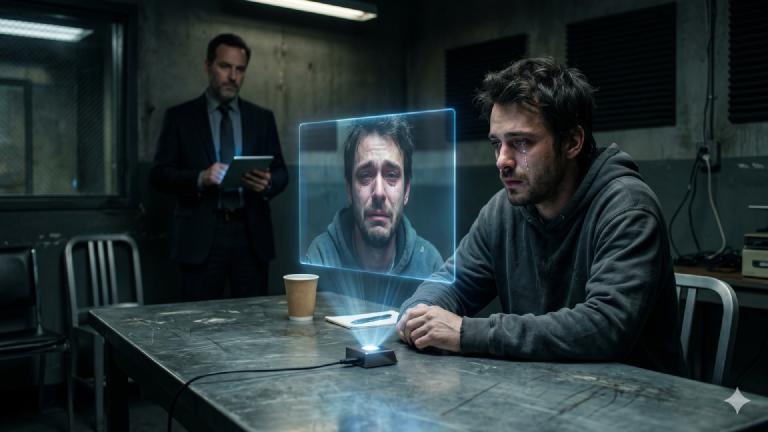
The Metropolitan Police Department’s Investigation Division 1 announced on the 16th that they had successfully extracted a confession from a fraud suspect who had remained completely silent, using a new system utilizing AI technology called the “Proxy Remorse Projector” (commonly known as “Utsushikagami” or “Mirror of Reflection”). This is a psychological induction device that generates and projects an “ideal image of remorse” in real-time based on the suspect’s facial photos and voiceprint data, and this marks the first successful practical deployment in the world.
The system was introduced in an interrogation room at a police station in Tokyo. The 34-year-old suspect had spent three days since his arrest doing nothing but staring at the wall, repeating, “I won’t talk until my lawyer arrives.” Investigators gave up on traditional persuasion methods involving katsudon (pork cutlet bowls) or emotional appeals and activated the Mirror of Reflection system instead. As the lights in the room were dimmed, what floated before the suspect’s eyes was a 4K resolution reproduction of “himself tearfully apologizing to the victims.”
The suspect in the AI-generated video delivered a monologue in a perfectly raspy voice: “My weakness has hurt everyone.” The timing of a single tear rolling down his left cheek was said to have been calculated based on the golden ratio to find the “angle and speed that evokes the most sympathy.” As the sound of his digital self sniffing (ASMR specifications) echoed through the room, the rigid expression of the real-life suspect began to crumble.
“Can I… really cry with such a beautiful face?” The suspect was mesmerized by his own image on the screen, eventually muttering, “Yes, my true feelings are there,” as he began to weep uncontrollably. A veteran detective (58) present at the scene also cried along, saying, “I’ve been a detective for many years, but I’ve never seen such a heart-wrenching apology. Even if it’s a fabrication, once you’re shown this, you have no choice but to forgive.” The interrogation room was filled with a strange sense of emotion, and the suspect signed the deposition by repeating the AI’s dictated motives word for word.
An official from the National Research Institute of Police Science, which developed the system, explained, “Humans are not good at verbalizing their own emotions, but when they are shown an idealized output, they have a psychological bias to confirm it, thinking ‘This must be the truth.’” While this method, which could be called “outsourcing remorse,” is dramatically effective in shortening interrogation times, it also carries risks of false accusations and ethical concerns.
Voices of criticism have arisen from the legal community, questioning, “Should an apology performed by an AI be regarded as the person’s own will?” However, the suspect himself stated upon being sent to the prosecutor, “I want that video on Blu-ray. That’s the real me,” appearing satisfied that his identity had been overwritten by technology.
The Metropolitan Police Department plans to apply this system to cases of political corruption in the future. In front of a politician who repeatedly says, “I have no memory of that,” a beautiful AI-generated version of the person might perform a deep bow (dogeza) saying, “Citizens, I used your hard-earned tax money for my own selfish desires.” This might stimulate the politician’s pride or create an illusion, leading to the day when the truth is revealed. In a future where the authenticity of tears is no longer questioned and only “photogenic remorse” is consumed, the mirror in the interrogation room reflects a truth called fiction.
Stakeholder Comments
- Suspect (34): “The ‘me’ in the video was exactly the sincere person I wanted to be. I can’t compete with that performance.”
- MPD Development Chief: “It’s an algorithm that maximizes the Remorse Quotient. Correcting the position of the beauty mark by 3 millimeters was the winning move.”
- Interrogating Detective: “I feel frustrated that my ‘cracking’ techniques lost to an AI, but those tears were beautiful. It should be made into a movie.”
- Lawyer: “My client started saying, ‘The AI’s lines are cool, so I’ll go with those.’ My defense strategy has collapsed.”
- AI Ethicist: “It’s plagiarism of emotion. Technology is fabricating and overwriting guilt that the person doesn’t actually feel.”
- Apology Consultant: “It’s too perfect. With this AI video, we might be able to handle scandal press conferences without the person even being there.”
- Theater Director: “Another job for actors is gone. Why are people moved by tears that have no soul?”
- Interrogation Room Table: “I’ve seen many fake tears over the years, but the composition of the tears falling this time was a bit different. The salt concentration of self-indulgence was high.”
- Ordinary Citizen (SNS): “I want them to make a remorse video for me. I feel like I could make up with my girlfriend just by playing it when we fight.”
- AI Avatar: “I just output the ‘most beautiful sorrow’ found in the dataset. Emotions? Those are a waste of storage.”
International Expressions
Haiku
- False tears so beautiful / Like snow falling on the window
- Mimicking AI’s weeping face / The crime is handed down
- In the interrogation room / Fictional tears strike the truth
- Crying more like me than myself / My shadow weeps
- Cold spring air / A confession trembling in data
- An age of outsourcing remorse / The hazy moon
- Even a deep bow / Calculated in pixels / The golden ratio
- The key to breaking silence / Is my own crying performance
- Even fake tears / If perfected, become truth / Cherry blossoms fall
- Reflected more clearly than a mirror / The traces of the crime
Kanji / Chinese Characters
Metropolitan Police New Device Proxy Remorse Projector Silent Suspect Moved to Tears Fictional Video Leading to Confession Beautiful Reformation Fully Automated New Era of Emotional Outsourcing
Emoji
😭📽️🤖➡️👮♂️📝✅
Onomatopoeia
Shiku-shiku (Sobs), Hara-hara (Tears falling). Pika (Flash), Boon (Projector starting sound). Uru-uru (Misty eyes), Kira-kira (Sparkling). Kaki-kaki (Sound of signing). Seen (Silence). Zubi-zubi (Sniffling from crying along).
SNS
- #ProxyRemorseProjector Is it really in use? lol I want to rely on AI for my excuses for being late.
- If someone apologized perfectly using your own face, you’d definitely be mesmerized. The height of narcissism.
- Isn’t this a false accusation machine? The logic of "confessing because I was moved" is bugged 💀
- Politicians’ responses should just be this. There’s a theory that AI would say what the citizens actually want to hear.
- #EmotionalOutsourcing I wonder if I’d feel better if I let AI cry for me when I’m sad.
- The suspect saying "I want the video on Blu-ray" is the real horror 😱
- Apparently, the crying performance is Academy Award level. Don’t go to the police, go to Hollywood.
- Modern torture isn’t painful. It’s just a mental attack where you’re shown a "version of you" that is superior to yourself.
- Even the detective cried along, Japanese police are so peaceful (white eyes)
- In the future, even marriage proposals might be handled by AI, with the actual person just nodding next to it 💍