Ultra-Cheap 'Lossy Compression Travel' a Hit for Gen Z, Arriving at 144p Resolution
With soaring airfares, cheap travel that compresses human bodies into data and transmits them is rapidly increasing. Users of the 'data-saving plan' who scrimp on data scrimp on transfer data, materializing at tourist destinations with severe block noise. In Kyoto, low-resolution tourists are overflowing, but they are rational: 'We'll change our faces with editing apps anyway, so our original form doesn't matter.' 'Physical data cap' accidents, where only one leg is left behind due to a lack of return data, are also frequently occurring.
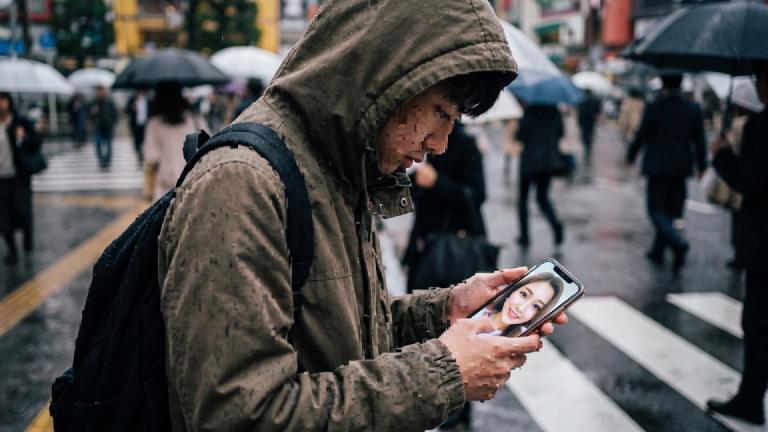
With spring break just around the corner, a new form of travel boasting mind-bogglingly low prices is exploding in popularity, particularly among young people. It is called “Lossy Compression Travel,” in which the human body is converted into quantum data and transmitted directly to the destination.
With airfares skyrocketing due to rising fuel costs, this service offered by a major telecommunication carrier is set at an unprecedentedly low price of just a few thousand yen round-trip. However, due to a surge in users opting for the extreme “data-saving plan” to cut down on data usage, tourist destinations are now wrapped in an unprecedented and bizarre spectacle.
In Kyoto, one of Japan’s premier tourist cities, a group of female college students posing with peace signs against the backdrop of Kinkakuji Temple has facial outlines that look like a cluster of blocky squares. Forget their outlines; even their facial expressions are indistinguishable. The “144p Economy Plan” they used utilizes lossy compression technology that trims the human body’s transfer data capacity down to a mere 0.01% of the original. A key characteristic is that when they materialize on-site, severe block noise and audio skipping occur.
Local residents cannot hide their bewilderment at the influx of tourists who have turned into “walking mosaics,” particularly from the perspective of landscape preservation. “They move in blocky motions, just like villagers in old NES games, and their voices are muffled like AM radio, so I can’t understand what they’re saying,” sighs the owner of a long-established Japanese inn. Before the vivid, traditional colors of historic temples and shrines, the sight of low-resolution pixelated masses forming queues looks exactly like a glitched virtual reality.
However, there is not a shred of despair among the young travelers themselves. When asked if they have any reservations about enjoying a trip with a resolution of 144p, they give an extremely rational response: “We’ll change our faces to someone else using AI editing apps anyway, and enhance the background too, so our original real-world form doesn’t matter at all.” To them, the resolution of the physical world is nothing more than “raw material,” serving as the ultimate solution that balances both time performance (efficiency) and cost performance.
On the other hand, this excessive data-saving is also causing serious accidents. There have been successive reports of “physical data cap exhaustion” (a physical version of running out of mobile data, known as “pake-ji” in Japanese) due to users watching too many videos on their smartphones during their trip, leaving them with insufficient data allocation for their return transfer. On the 25th, an incident occurred where the data for only a traveler’s right leg was blocked by the transfer limit, leaving the lower calf and foot stranded on the grounds of Yasaka Shrine. “I have no choice but to hop around on one foot until my data allowance resets next month,” said the victim, whose voice was cut off like low-bitrate MP3 audio.
New-era tourists prioritize how they look in digital spaces over the resolution of physical reality. Even if it means risking their bodies being sliced up due to “insufficient storage,” they still choose to travel. It seems that the “authentic self” we once cherished simply couldn’t fit into a 2,980 yen monthly data plan.
Stakeholder Comments
- A Youth: “Actually, it helps that my real pores aren’t visible. I don’t even need to remove my makeup, making it the ultimate time-saving lifehack.”
- Telecom Carrier Representative: “The transfer speed when under data restrictions is 128 kbps. Since complete restoration of the physical body may take several days, please plan your data usage responsibly.”
- Kyoto Resident: “While the local landscape ordinances are strict about building colors, can’t we regulate people being pixelated? It makes my eyes hurt.”
- AI Editing App: “It is hard to infer and autocomplete when the original face is only 144p, but that is where my deep learning shines. I will generate a completely different person for you.”
- Tourism Agency Official: “We would like to positively evaluate this as opening up a new market for low-resolution inbound tourism demand. You could say it is eco-friendly tourism that does not affect the actual landscape.”
- A Right Leg Stranded by Data Cap: “Master, please buy extra data quickly and let me return to Tokyo. The nights in Kyoto are cold.”
- Orthopedic Surgeon: “A patient came in after materializing with their joint facing the wrong way due to a transmission error. Even if they blame it on the Wi-Fi environment, that is out of my jurisdiction.”
- College Student Short on Data: “My arm will come back next month, so until then, I’ll get by with a one-handed controller. It’s a bit inconvenient, but it was cheap, so it’s all good!”
- Digital Estate Organizer: “Lately, rather than managing left-behind digital data, my job increasingly involves sorting actual physical parts left at destinations and mailing them back to families.”
- Quantum Router: “I process data for tens of thousands of people daily, but it’s a known bug that sometimes packets of other people’s memories get mixed in. Please just deal with it.”
International Expressions
Haiku
- Snap a mosaic / Smile frozen in low-res / A journey in spring
- Out of data now / In Kyoto’s beautiful spring / A foot left behind
- Resolution drops / Yet the spring romance heats up / Blurry hearts entwine
- With compressed bodies / Passing under flower gates / In the breeze of spring
- Pixelated face / Melting in the falling blooms / Cherry blossom storm
- Data cap is reached / Only the arm stays behind / In the spring haze
- Saving on data / Walking blocky through the crowd / Cherry blossom view
- Quality lowered / Casting away the real self / A dream in the spring
- Better than the real / Filtered to perfection now / Balmy day in spring
- Data cap exceeded / Left behind in the twilight / At the end of spring
Kanji / Chinese Characters
人体量子圧縮旅行急増 節約利用低画質実体化 京都街角四角形顔続出 加工前提原形無視若者 通信量不足片足残頻発
Emoji
✈️❌ ➡️ 🗜️🚶♂️🚄💨 🏞️📸 ➡️ 🔲👾🤳✨ 📉📶 ➡️ 🦵😱🏨
Onomatopoeia
Jittery, beep-beep-beep. Bzzt, crackle-crackle. Cut off, poof! Pixelated, swipe! Left alone, shiver.
SNS
- #144pTravel
- Eating Yatsuhashi while looking totally pixelated lol #LowResKyoto
- Out of data and left only my bangs behind lmao #DataCapGrave
- Theory: Low-res reality actually makes it easier to beautify with AI #PeakEfficiency
- Wait, why does everyone’s face look like Minecraft…?
- Save some data for the trip back! Friendly advice from a senior who forgot their ankle in Kyoto.
- #LossyCompression
- Quality is so low that my friend’s voice sounds like helium gas, too funny
- Maybe real-world resolution was actually over-spec all along?
- If you have the money to buy extra data, just take the Shinkansen lol #Facts