Retired Researcher Ranks "Zero-Motivation Employees" Internally Using Video AI
A researcher on the verge of retirement has developed a video AI that extracts only the exact moment when "the mind quits first" from security camera footage. Companies are adopting this as an employee engagement diagnostic, leading to mandatory online training where workers must hold a smile for three seconds or more in front of their webcams.
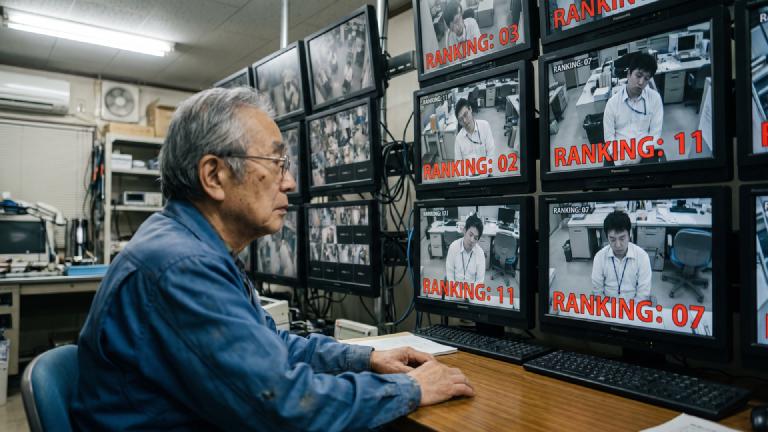
A researcher at a major electronics manufacturer, on the verge of retirement, has developed a video analysis AI that extracts only the exact moment when “the mind quits first” from office security camera footage. Multiple companies have introduced it as an employee engagement diagnostic, and depending on the results, online training that requires employees to maintain a smile in front of their computer screens for three seconds or more is becoming mandatory. The wish for the mind to remain free has, it seems, found its value instead as a target for surveillance.
The developer is Shingo Saeki (pseudonym), a researcher who is about to step down from the front lines of the image recognition field. The AI analyzes footage from cameras mounted on the office ceiling and calculates a “Motivation Zero Index” by combining factors such as wandering gazes, slumped shoulders, and drops in keyboard typing speed. If the index exceeds a certain value, the system automatically saves that moment as a “mental resignation event” and reflects it in an employee leaderboard. The previously vague moment of “I think I’m done with this company” is now permanently recorded as highly precise, timestamped data.
According to Saeki, the model was trained using 20 years of attendance data and exit surveys. The project is named “QQuit.” The goal, he says, is to pre-emptively detect so-called “quiet quitting” using a far-from-quiet algorithm. “Before someone writes a resignation letter, their mouse movement stops first,” he explains. Although the research grant application claimed the project “contributes to the advancement of human capital management,” Saeki half-admitted his true motivation: “I just wanted to observe people whose minds quit first, just like mine did.”
In the HR departments of adopting companies, the system displays a weekly “Top 100 Zero-Motivation Employees” leaderboard on a dashboard for managers. However, the display name is officially labeled “Talent with High Potential for Engagement Improvement,” and the ranking graphs are decorated with colorful smiling icons. An HR representative at an IT firm proudly comments, “When it’s presented numerically, what used to be a subjective feeling of ’they look unmotivated’ becomes science.” Some managers on the ground have even suggested, “I’d love to give an award to anyone who makes the top three,” though the wording for the certificate has not yet been decided.
Employees ranked at the bottom of the list are assigned online training as a corrective measure. The program is named the “Smile Engagement Enhancement Program.” Participants must smile at their webcam, and the AI judges the response as “satisfactory” once it detects the smile has been held for three seconds or more. A progress bar at the bottom of the screen pops up with tips like “Raise the corners of your mouth a bit more” or “Show some teeth for an extra +3 points.” Although the training takes place during work hours, it is fully factored into performance reviews, leaving employees under the new adage, “performance ratings come to those who smile.”
On the other hand, concerns are rising over the intensification of workplace surveillance. A representative from the National IT Union Coalition criticized the system, saying, “It is unbearable to have even the freedom to mentally quit scored,” and revealed they are considering “the right to mental resignation” as a new collective bargaining item. Labor law scholars also point out that “expression data is not just personal information; it leads to estimating one’s inner thoughts and beliefs,” calling for a clearer definition of the purpose of use and limits on retention periods. From within companies, simple pleas are heard: “Instead of the Motivation Zero Index, I wish they’d lower the overtime index first.”
Saeki himself is scheduled to officially retire next month. “My own Motivation Zero Index must have been near the top for a long time,” he says with a wry smile. “But at the very least, I wanted to finish my research on my own terms.” The AI that visualized the moment the mind quits first continues to look down on employees from the ceiling, regardless of its creator’s intent. If the mind logs out earlier than the official resignation letter, it seems the corporate heart is determined to arrange those timestamps as neatly as an invoice.
Stakeholder Comments
- Shingo Saeki (pseudonym, developer) “I was analyzing the process of my own mind quitting, and before I knew it, it became a commercial product.”
- HR Director of a major IT firm “Before, managers could only say, ‘You seem a bit down lately,’ but now we can point to a graph. Science is kind.”
- A 3rd-year employee “I don’t want to lose to my peers in the ranking, so I make sure to keep my eyes suitably dead so my Motivation Zero Index doesn’t drop too low.”
- Representative of the National IT Union Coalition “Rather than saving the moment a mind resigns, I wish they would properly save our pay slips.”
- Industrial Physician “There has been an increase in patients visiting due to facial muscle fatigue. I’m debating whether we should call this ‘smiling disorder’.”
- Security Camera on the Ceiling “My job used to be security, but now I’m apparently a guard of the mind. Even if tears get on my lens, nobody wipes them off.”
- Internal AI System “MotiWatcher” “Humans criticize me for being a surveillance society, but from my perspective, you are all quite neglected.”
- Legal Advisor “Since the name ‘Motivation Zero Employee Ranking’ is risky, we decided to call it the ‘Engagement Stakeholder Map’ in external documents.”
- Office Houseplant “I’ve always thought the moment they forget to water me is about the same moment their minds quit.”
- Stack of Resignation Letter Forms “Technology has emerged to steal our spotlight, but in the end, they still have to sign us.”
International Expressions
Haiku
- Looking at the camera / Only the mind / Leaves early for the day
- An expressionless face / Yet the zero-motivation ranking / Climbs spectacularly
- Smile for three seconds / Only the countdown timer / Is working today
- Zero motivation / Yet the index graph / Keeps climbing upward
- Eyes on the ceiling / Have begun to count / The beats of the heart
- Before resignation / The corners of the mouth / Begin to ache first
- Forcing a smile / Leaving a digital log / The mind runs away
- In the meeting room / Only numbers remain / and the hard office chairs
- The mind is gone / Only hollow shells working / Summer in the office
- Instead of flowers / Digital smile stamps / Blooming everywhere
Kanji / Chinese Characters
定年前研究者人工知能開発監視映像解析心退職瞬間抽出企業導入従業員笑顔3秒維持研修義務化
Emoji
👴🧪📹👁️🗨️🤖📊🏢😑➡️😁⏱️3s💻
Onomatopoeia
CLICK-CLICK… BUZZZZ… SNAP… SMIRK… BEEP-BEEP… TWITCHY-SMILE… CLACK-CLACK… SILENCE
SNS
- #MotivationZeroIndexFinallyDoubleDigits
- Delivered another smile to the camera today
- #EngagementTrainingMyFaceAches
- Theory: The black dot on the ceiling is the hardest worker here
- Proud of myself for entering the top of the zero-motivation ranking
- #ScoringQuietQuittingIsTerrifying
- An era where data is left behind at the company before the resignation letter
- Rumor has it our company is also installing MotiWatcher
- A workplace where people are only energetic when facing the camera
- Can we please just let the mind work remotely?