City to Rectify 'Nostalgia Gap': Non-Riders Recognized as 'Veterans' of Defunct Railway Fan Clubs
What arrived in the morning mailbox wasn't a bill, but a membership card printed with gold letters saying, 'Thank you for your many years of support.' Even young people who have never ridden the train—or for whom the line vanished before they were even born—are now granted the right to say, 'It used to be crowded back then.' The city explains this as 'equalizing speaking time for old stories.'
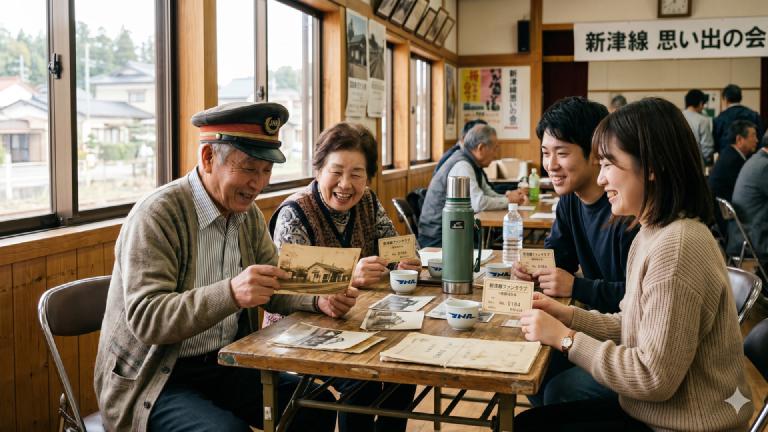
What arrived in the morning mailbox wasn’t a bill, but a membership card printed with gold letters saying, “Thank you for your many years of support.” Even young people who have never ridden the train—or for whom the line vanished before they were even born—are now granted the right to say, “It used to be crowded back then.” The city explains this as “equalizing speaking time for old stories.”
In regional nostalgia, there are often invisible “reserved seats.” That line had windows that fogged up in winter; the station soba at the terminus was strangely sweet; there weren’t enough hand straps in the morning. Only those who actually rode the train held the right to speak, while younger residents could only bounce between “I see” and “That sounds precious.” It is this quiet sense of defeat that the city has flagged as a problem.
This month, the city launched the “Nostalgia Gap Rectification Project.” The target is the non-rider generation, including residents who weren’t even born when the line was abandoned. The gold-lettered membership cards delivered to their mailboxes state that they are already registered as “Veteran Members” of the Defunct Railway Fan Club. The city hall proudly declares, “The administration guarantees the opportunity to access memories.” It’s quite a bold claim.
Under this system, basic statements like “It was crowded back then” or “The wooden floors creaked” are officially permitted during community meetings or casual chats after family funerals. Supplementary classes have even begun at the local community center. Popular sessions include “The Angle of Looking into the Distance Before a Black-and-White Photo,” “Expressing Slight Dissatisfaction with Non-Existent Transfers,” and an advanced workshop on “Slightly Belittling the Replacement Bus.” Those with no memory of the line are the most diligent in their preparation—a phenomenon reminiscent of traditional exam systems.
The anomaly accelerated in the middle of the project. The city’s official app began automatically generating personalized recollections based on location data and weather, such as “The interior of the car felt a bit damp on rainy days.” Young people posted sepia-toned selfies at old station sites, captioned with, “I used to be shaken about in these cars when I was little.” It was the line that was “little” (in scale); the posters weren’t even born yet. But the “Like” button is faster than fact-checking.
Among the actual veteran riders, expressions are mixed. While some are indignant, asking, “Are they even distributing the hardships?” others shrug, saying, “It’s better than the memory vanishing without anyone knowing.” Local historians criticize the move: “The administration distributing brand-new memories to replace worn ones isn’t preservation; it’s mass production.” However, for the young people who have long stood outside the circle of conversation, the absence of memory itself was a form of long-term “denial of boarding.” Hearing that, one cannot simply laugh it off.
The city continues to explain that “equalizing the speaking time of old stories is the first step toward regional inclusion.” The logic is that if residents equally receive taxes, disaster information, and neighborhood circulars, then nostalgia should also be a public good. It is interesting to note that while this town often falls silent when discussing its future, it is remarkably agile when it comes to the redistribution of its past. The tracks have long since vanished, but the right to say “the old days were better” has now become the most frequent form of municipal transportation.
Stakeholder Comments
- City Cultural Symbiosis Section Chief: “We want to end the hereditary nature of experience. Nostalgia needs barrier-free access too; the ‘steps’ are usually built from the heroic tales of elders.”
- Mayor: “Nostalgia is infrastructure, just like roads. We can’t pave it, so we started by distributing membership cards.”
- Local Historian: “Memories are historical materials, not novelties. When you print them in gold letters, most things start to look cheap.”
- Transportation Sociologist: “It symbolizes an era where the sense of participation outruns the facts. It’s fascinating as a research subject, but there’s no escape once it’s implemented at family gatherings.”
- University Student (22): “For the first time, I could say to my grandfather, ‘That station was cold in the winter, wasn’t it?’ It was half conversation and half courage.”
- Office Worker (27): “Thanks to the membership card, my reactions at drinking parties have been promoted from ‘Oh really?’ to ‘I know exactly what you mean.’ People are mostly driven by the need for validation.”
- Former Commuter (81): “At first I was angry, but it’s better than nobody carrying on the story. Nowadays, the young kids sigh even better than I do.”
- Station-front Cafe Owner: “Since the number of ‘veterans’ increased, a single cup of coffee stretches the old stories by two more stations. Sales are flat, but the stay-time is ‘Express’.”
- Weeds on Abandoned Tracks: “Suddenly we’re being photographed instead of stepped on, and we’ve even been given ‘meaning.’ Even plants can climb the social ladder.”
- Nostalgia: “I’m usually something that wells up naturally, but once a budget is attached, I tend to sit up straighter. I’m quite weak to that kind of public funding.”
International Expressions
Haiku
- Born too late for tracks / Yet now a veteran fan / Membership arrived
- Gold-lettered card comes / Joining the defunct fan club / A morning in spring
- “It was crowded then” / Says one who never even rode / Hazy spring weather
- Old stories of past / Distributed equally / Warm breeze is blowing
- Abandoned station / Bench I have never sat on / Yet I nod my head
- The replacement bus / Today plays a minor role / Yellow dust flying
- Nostalgia sent out / By the city hall today / Swallows are coming
- Before a photo / Practicing looking afar / The hazy moon
- Whistle-less sky / Letting out a heavy sigh / Mountains are laughing
- Yesterday is more / Convenient than the future / Town in the springtime
Kanji / Chinese Characters
Morning Mailbox Bill Absent Gold Letters Years Support Thanks Membership Card Arrival Non-Rider Generation Defunct Line Veteran Certification Old Story Speaking Time Equalization Explanation
Emoji
📬✨🎫🚃❌👶➡️🧓🚉🗣️⚖️
Onomatopoeia
Click, rustle, sparkle. “Wait, I haven’t even ridden it yet…” Clatter-clatter, memories I don’t have are swelling up. Pondering, chatting, buzzing. Tap-tap, now you’re a veteran.
SNS
- Became a “veteran” of a line I’ve never ridden. Is nostalgia finally a distribution system? #NostalgiaGap #VeteranCertification
- For the first time, I could use “It was crowded back then” with my grandfather. The effect was more than I imagined. #RailwayFanClub #NonRiderGeneration
- Zero real experience, one membership card. A morning where my past arrives before my resume. #DemocratizedMemories
- I kind of like that the city hall is faster at distributing the past than the future. #LocalGov #Nostalgia
- Isn’t this the ultimate tool for family gatherings? You can buy a “ticket” to the conversation just by saying “That station, you know…” #OldStories #RightToParticipate
- As someone from the “replacement bus” generation, it’s a bit complicated. But I laughed. #TransportHumor #DefunctLine
- The phrase “ending the hereditary nature of experience” really hits home. #Fairness #SharedExperience
- The real veterans were the kindest of all, and it made me cry. Nostalgia is about who you talk to. #Community #Memory
- I lost to the AI that generated “I feel like the floor was a bit slippery on rainy days.” #RecollectionAI #Relatable
- Are you going to distribute “I used to go there often as a kid” next? #MunicipalWatch #DemocratizedMemories